
Table party lighting: 5 mistakes to absolutely avoid
The lighting of your festive table sets the mood for your most memorable evenings. A poorly chosen or incorrectly positioned fixture can turn your refined dinner into a disappointing experience. Discover the most common mistakes that compromise the festive atmosphere and learn how to avoid them with advice from interior lighting experts.
Mistake #1: Choosing lighting that is too cool or too intense
The most common mistake is to favor lighting that is too powerful or with cool tones. A color temperature above 4000K instantly turns your festive table into a clinical environment, undermining the desired conviviality.
To create the optimal festive lighting atmosphere, follow these technical parameters:
- Color temperature: 2700K to 3000K (warm white)
- Intensity: 150 to 200 lumens per square meter for the dining area
- CRI (Color Rendering Index): minimum 80 to preserve the natural colors of dishes
Pendants with integrated dimmers allow you to adjust the intensity according to the moments of the meal: brighter for the aperitif (200-250 lm/m²), then dimmed for dinner (100-150 lm/m²).
Mistake #2: Incorrectly positioning the main light fixture
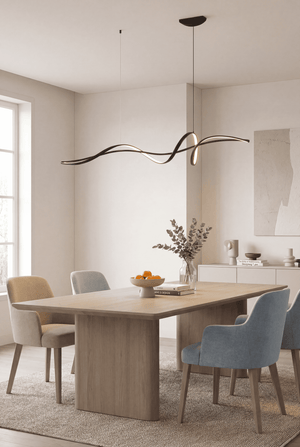
The positioning of your dining table pendant light directly influences guests' visual comfort and the presentation of dishes. An unsuitable height creates shadows or glare.
Recommended suspension heights:
- Standard table (75 cm high): suspension at 70-80 cm of the surface
- Ceiling height 2.50 m: minimum height 2.10 m from the floor
- Table for 8 people: allow 15 cm clearance on each side
The optimal beam angle for table lighting ranges between 60° and 90°, ensuring even distribution without creating shadow zones over the guests.
Mistake #3: Mixing incompatible color temperatures
The anarchic combination of light sources with different color temperatures creates a disturbing visual cacophony. Yellow candles (2000K), cool LEDs (5000K), and halogen bulbs (3200K) cannot coexist harmoniously.
For a consistent warm, friendly light:
- Favor a maximum difference of 500K between your different sources
- Use only warm white LEDs (2700K-3000K) for the main lighting
- Complete with LED candles of the same temperature
Our range of designer chandeliers features professional-grade LEDs, ensuring stable color temperature and a CRI above 90 for faithful color rendering.
Mistake #4: Neglecting complementary ambient lighting
Limiting yourself to a single dining room fixture greatly impoverishes the atmosphere. Festive lighting requires several light levels to create depth and intimacy.
Multi-layer lighting strategy:
- General lighting: 60% of total light
- Accent lighting: 30% distributed on decorative elements
- Decorative lighting: 10% for the finishing touches
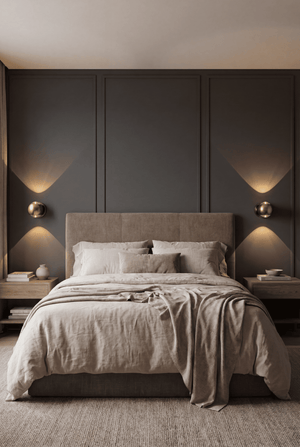
Integrate wall sconces with indirect lighting to enhance the architecture of your dining room. These fixtures, positioned at 1.70-1.80 m high, diffuse a soft light that enhances the atmosphere without competing with the main lighting.
Mistake #5: Ignoring dimming and light modulation
A static decorative table light does not adapt to the different phases of the meal. The light intensity should evolve to naturally accompany the progression of your evening.
Recommended time schedule:
- Welcoming guests: 100% intensity (250-300 lm/m²)
- Aperitif: 80% intensity (200-240 lm/m²)
- Meal service: 60% intensity (150-180 lm/m²)
- End of evening: 40% intensity (100-120 lm/m²)
Modern dimmers, compatible with LEDs, allow for this gradual adjustment. Look for flicker-free models to maintain visual comfort throughout the meal.
Proportions and sizing: adapt the fixture to your table
The size choice of your fixture directly influences the visual balance of the whole. Inadequate proportions create a sense of architectural imbalance.
Proportionality rules:
- Rectangular table: fixture length = 50-66% of the table length
- Round table Ø 120 cm: pendant Ø 60-80 cm maximum
- Table for 6 people: total output 800-1200 lumens
For large tables, favor several aligned pendant lights rather than an oversized fixture. The optimal spacing between two pendants is 1.5 times their diameter.
Advanced techniques to enhance your festive lighting
Lighting expertise reveals technical subtleties that distinguish an amateur installation from a professional arrangement.
Managing light contrasts
The contrast ratio between main lighting and ambient lighting should not exceed 3:1 to avoid eye strain. This proportion ensures a smooth transition between different lighting zones.
Color quality and color fidelity
A CRI above 90 reveals the subtle nuances of your dishes and enhances your fine tableware. This often-overlooked feature transforms the visual perception of your table.
Directional lighting and staging
Use adjustable accent lamps to create light accents on your centerpieces. A 30° beam angle focuses the light on decorative elements without spilling onto the plates.
Technical solutions for every configuration
Each space requires a personalized approach according to its architectural constraints and dimensions.
Open dining room
In an open space, visually define the dining area with differentiated lighting. The color temperature above the table (2700K) can contrast with the general lighting (3000K) to create a sense of intimacy.
Low ceiling (less than 2.40 m)
Opt for ultra-flat ceiling lights or short pendant lights. The minimum distance of 65 cm between the fixture and the table remains essential to avoid glare.
Extendable table
Plan for a scalable system: electrified rail allowing the fixture to be moved or multiple pendants that can be activated according to the length of the extended table.
Maintenance and optimization of your installation
The longevity of your festive table lighting depends on regular maintenance and seasonal adjustments.
Quarterly checks:
- Diffuser cleaning: 15-20% increase in brightness
- Dimmer control: no flickering
- Color temperature test: consistency maintained
Professional quality LEDs retain 80% of their luminous flux after 25,000 hours of use, or about 15 years of normal domestic use.
Frequently asked questions about festive table lighting
At what height should a pendant light be installed above a table for 8 people?
For a standard table for 8 people (200-220 cm long), install your pendant light between 70 and 80 cm above the table surface. This height ensures even lighting without hindering conversation and allows for a minimum clearance of 2.10 m from the floor.
What light output should I choose to effectively light my festive table?
Plan for 150 to 200 lumens per square meter for the main lighting of your table. For a table seating 6 people (surface area about 4-5 m²), allow for a total of 800 to 1000 lumens, adjustable with a dimmer to adapt the ambiance to different moments of the meal.
How can I avoid unsightly reflections on dishes and glasses?
Choose a fixture with a beam angle of 60 to 90° and avoid spotlights that are too directional. Favor a CRI above 80 and supplement with indirect lighting (wall sconces) to reduce contrasts and eliminate annoying reflections.
Which color temperature guarantees the most welcoming ambiance?
Opt for a color temperature between 2700K and 3000K (warm white). This chromatic range recreates the cozy atmosphere of candlelight while maintaining excellent readability. Absolutely avoid temperatures above 3500K, which create a cold and impersonal atmosphere.