
Complete guide to choosing the perfect wall light: technical criteria and expert advice
The indoor wall light stands out as one of the most versatile lighting elements in the home. Combining functionality and aesthetics, it allows you to create personalized lighting atmospheres while optimizing floor space. Whether you want to light a hallway, highlight a painting, or create a cozy atmosphere in your living room, choosing your wall light requires careful consideration of several technical and decorative criteria.
In a market where options are multiplying, between modern LED wall lights, vintage models, or contemporary designer creations, it becomes essential to master the key parameters to make the right investment. This expertise will help you avoid common mistakes and select the wall lighting that will truly transform your interior.
The fundamental technical criteria for choosing your wall light
Luminous power and luminous flux: calculating your lighting needs
The luminous power expressed in lumens is the first criterion to consider when choosing your indoor wall light. For general lighting, allow for 100 to 150 lumens per square meter in a living room, while a hallway will require about 50 to 100 lumens per square meter. For accent lighting, such as highlighting a work of art, a wall light of 200 to 400 lumens will generally suffice.
Modern LED wall lights offer an excellent luminous efficiency/power consumption ratio. With a power of 8 to 12 watts, an LED wall light can produce the equivalent of a traditional 60-watt bulb, or about 800 lumens. This energy efficiency translates into substantial savings on your electricity bill, with a lifespan of up to 25,000 to 50,000 hours.
Color temperature: creating the desired atmosphere
The color temperature measured in Kelvin directly influences the atmosphere of your space. For warm and intimate wall lighting, choose a temperature of 2700K to 3000K (warm white). This tone is perfect for bedrooms, living rooms, or relaxation areas where you want to create a cozy ambiance.
For workspaces, hallways, or kitchens, opt for a neutral white at 4000K which provides more energizing lighting without being dazzling. In bathrooms or offices requiring high visual precision, a temperature of 5000K to 6500K (cool white) will be more suitable, although less common for residential lighting.
Color Rendering Index (CRI): preserving visual authenticity
The CRI or Color Rendering Index evaluates your wall light’s ability to faithfully render colors. A CRI above 80 is considered good, while an index of 90 or more guarantees excellent quality for natural color reproduction. This feature is crucial if you use your designer wall light to illuminate artworks, reading areas, or zones where color perception matters.
High-end wall lights often feature LEDs with a CRI above 95, allowing for an almost perfect rendering of shades. This quality sometimes justifies a higher investment, especially for lighting galleries, dressing rooms, or spaces dedicated to creative activities.
Types of wall lighting and their specific applications
Direct lighting: performance and luminous efficiency
Direct lighting with a wall light projects light directly onto the area to be lit, offering maximum efficiency with a beam angle generally between 30° and 60°. This type of lighting is ideal for reading, with installation recommended at 1.70m to 1.80m from the floor to avoid glare.
Direct lighting wall lights often feature high-performance optics and reflectors that optimize light distribution. For an office or work surface, these models can deliver up to 300 lumens per square meter, ensuring optimal visual comfort for tasks requiring high precision.
Indirect lighting: ambiance and visual comfort
Indirect lighting creates a diffuse and even light by reflecting the light flow on surrounding surfaces. This technique eliminates harsh shadows and excessive contrasts, creating a soothing atmosphere especially appreciated in bedrooms and living rooms. The beam angle generally extends to 120° or more, ensuring an even distribution of light.
Wall lights with indirect lighting require a slightly higher power to compensate for reflection losses—plan for about 20% more lumens compared to an equivalent direct lighting. Nevertheless, this setup offers exceptional visual comfort and enhances wall textures and architectural features.
Bidirectional lighting: versatility and staging
Bidirectional wall lights combine upward and downward lighting, creating sophisticated lighting effects on your walls. This setup allows you to efficiently light a space while creating decorative plays of shadow and light. Installation should respect a minimum height of 2.10m from the floor to avoid direct glare.
These models often feature separate LED sources for each direction, sometimes allowing independent intensity control. This flexibility enables personalized lighting scenarios depending on the time of day and activities.
Compatibility and installation: essential technical aspects
Types of bases and bulb compatibility
The compatibility of bulb bases determines your options for upgrades and maintenance. E27 (large screw base) and E14 (small screw base) remain the most common for wall lights, offering a wide choice of LED bulbs in all wattages and color temperatures. These formats ensure easy replacement and optimal availability of consumables.
GU10 and G9 bases are mainly used in contemporary design wall lights with high-performance integrated LEDs. Although more compact, these solutions sometimes limit replacement options. High-end models now feature non-replaceable LEDs but come with a 5 to 10 year warranty, offering exceptional reliability.
Dimmers and dimmability: controlling the lighting ambiance
Compatibility with dimmers (dimmable function) is a major advantage for customizing your wall lighting. Check that your wall lights support dimming, especially with trailing edge or leading edge technologies depending on your existing electrical installation. This feature allows you to adjust the lighting from 10% to 100% of the nominal power.
Dimmable LED wall lights sometimes require specific LED-compatible dimmers to avoid flickering or a limited dimming range. Investing in a quality dimmer ensures smooth and silent dimming, also extending the lifespan of your LEDs.
Protection ratings and installation safety
The IP protection rating indicates the level of resistance your wall light has to water splashes and dust. For use in dry indoor areas, an IP20 rating is more than sufficient, while bathrooms require a minimum IP44 rating in zone 2 (within 60cm around the bathtub or shower).
The electrical installation must comply with the current NFC 15-100 standards, particularly regarding lighting circuits protected by a 16A maximum circuit breaker. For heavy wall lights or installations on hollow partitions, use suitable anchors that can support at least 20kg per fixing point.
Styles and designs: harmonizing aesthetics and functionality
Modern and contemporary wall lights
Modern designer wall lights favor clean lines and premium materials such as anodized aluminum, brushed steel, or opal glass. These models often feature advanced LED technologies with sophisticated optics, providing high-performance lighting in a minimalist design. Matte or satin finishes prevent unwanted reflections while blending harmoniously with contemporary interiors.
The current trend highlights simple geometric shapes: cylinders, parallelepipeds, or spheres, available in various sizes. These wall lights are discreet by day and make a decorative impact when lit, creating sophisticated architectural lighting effects.
Classic and traditional wall lights
Classic-style wall lights retain their appeal thanks to authentic materials such as patinated brass, bronze, or wrought iron. These models now incorporate LED sources that preserve the traditional look while offering the advantages of modern technology: energy savings, durability, and quality lighting.
Fabric or glass lampshades create a soft diffusion that is especially appreciated in classic interiors. Be sure to choose materials that are heat-resistant and easy to clean to maintain aesthetic quality over time.
Industrial and vintage wall lights
The industrial style appeals with its authenticity and robustness, using raw materials such as black steel, aged copper, or raw aluminum. These wall lights are often inspired by factory or workshop lighting, reinterpreted for modern homes. The metal reflectors optimize light distribution while emphasizing decorative character.
The integration of visible filament LED bulbs allows you to maintain the vintage aesthetic while benefiting from modern energy efficiency. These light sources reproduce the warm look of old incandescent bulbs with a lifespan of 15,000 to 25,000 hours.
Optimal positioning and installation of your wall lights
Recommended mounting heights according to use
The installation height of your wall light determines its effectiveness and your visual comfort. For general hallway lighting, install your wall lights at 2m to 2.2m from the floor, allowing for optimal diffusion without risk of glare. In a bedroom, for reading in bed, a height of 1.2m to 1.4m from the floor is ideal.
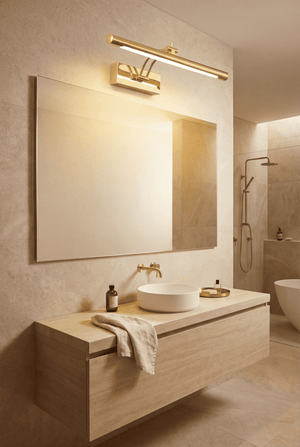
For mirror lighting in a bathroom, position the wall lights at 1.7m to 1.8m from the floor, which is approximately at the average user's eye level. This position avoids casting shadows on the face while ensuring uniform lighting for daily care.
Distances and spacing for even lighting
The spacing between wall lights should respect certain proportions to ensure even light distribution. In a hallway, space your wall lights 1.5m to 2.5m apart depending on their luminous power and the desired effect. For decorative lighting, this distance can be reduced to 1m to 1.5m to create a more dynamic visual rhythm.
The distance from corners and openings also influences the effectiveness of your wall lighting. Install your wall lights at least 30cm from wall corners to avoid overly pronounced shadow areas and ensure optimal light diffusion.
Architectural integration and staging
Integrating your wall lights into the existing architecture requires a preliminary analysis of volumes and proportions. In a room with high ceilings, choose larger wall lights or install them in pairs to visually balance the space. Moldings and decorative elements can serve as guides for positioning, creating architectural harmony.
To highlight a staircase, install your wall lights following the line of the handrail, with regular spacing that respects the geometry of the structure. This approach creates an elegant visual guide while ensuring safe movement at night.
Buying tips and selection by room
Wall lights for living room and living spaces
In the living room, choose designer wall lights with indirect lighting to create a warm ambiance without glare. Opt for a color temperature of 2700K to 3000K and a power of 400 to 800 lumens depending on the size of the room. Dimmable wall lights offer valuable flexibility to adapt the lighting to different times of the day.
For the selection of designer wall lights in your living room, consider harmony with your existing furniture. Coordinated metallic finishes with furniture handles or decorative elements create a refined aesthetic coherence.
Wall lighting for bedrooms
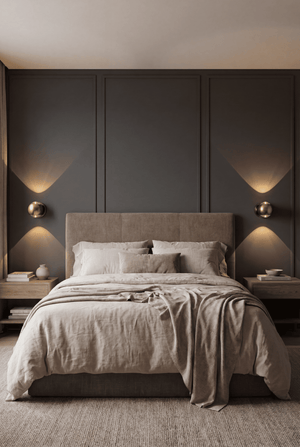
Bedrooms require soft and adjustable lighting, with wall lights offering different lighting scenarios. For reading in bed, install directional wall lights at 1.2m-1.4m from the floor, with a power of 200 to 400 lumens and the possibility of dimming. Articulated arms allow precise adjustment of the light direction.
Ambient lighting can be provided by wall lights with indirect diffusion and a maximum temperature of 2700K to promote relaxation and prepare for sleep. Avoid overly powerful lighting or cool temperatures that disrupt the natural circadian rhythm.
Wall lights for hallways and circulation areas
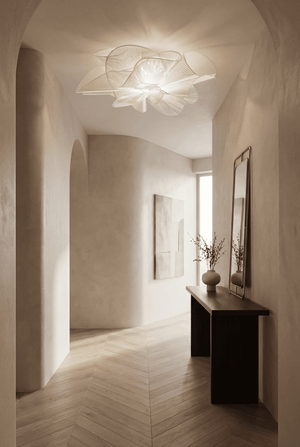
Hallways require functional and safe lighting without causing glare. Install wall lights every 2 to 3 meters with a power of 300 to 500 lumens each, at a height of 2m to 2.2m. Motion sensor models provide appreciable convenience and achieve substantial energy savings.
For narrow spaces, opt for wall lights with a low projection (less than 15cm from the wall) to maintain circulation. Sleek designs and indirect or bidirectional lighting visually enhance these often overlooked areas.
Bathroom: specific constraints and suitable solutions
Bathroom lighting requires wall lights with at least IP44 certification to withstand water splashes. Mirror lighting requires two side wall lights or a top bar delivering 300 to 500 lumens each, with a CRI above 80 for accurate color rendering during grooming.
The neutral color temperature (4000K) is perfectly suited for this use, providing energizing lighting in the morning while remaining pleasant in the evening. Dimmers compatible with humidity allow you to adjust the intensity according to the time of use.
Maintenance and optimization of your wall lights
Regular maintenance and cleaning
Regular maintenance of your wall lights ensures their optimal luminous performance and extends their lifespan. Clean the diffusers and reflectors monthly with a slightly damp microfiber cloth, avoiding harsh chemicals that could damage the materials. For metal wall lights, use specific products according to the finish (brass, chrome, anodized aluminum).
Dust accumulation significantly reduces luminous efficiency, sometimes causing up to 20% loss after just six months without cleaning. This simple preventive maintenance allows you to maintain the rated performance of your wall lights while preserving their appearance.
Replacement of light sources
For wall lights equipped with replaceable bulbs, monitor the gradual degradation of luminous flux and any changes in color temperature indicating an approaching end of life. Quality LEDs generally maintain 80% of their initial output after 25,000 hours of use, or about 10 years of normal usage.
When replacing, strictly follow the original technical specifications: maximum power, socket type, dimensions, and color temperature. Using non-compliant bulbs can damage the electronic circuit of modern wall lights and void the manufacturer's warranty.
Evolution and modernization of the installation
Technological advances allow you to modernize your existing wall lights by replacing halogen sources with compatible LEDs, reducing consumption by 80% while improving lifespan. This transition sometimes requires adapting existing dimmers to maintain dimming functionality.
Adding smart control systems (motion detectors, timers, home automation) can transform your traditional wall lights into connected solutions, offering new usage possibilities and energy savings. These upgrades are generally easy to integrate into the existing installation.
Budget and investment: optimize your purchase
Price ranges and quality-performance ratio
The wall light market ranges from €30 for entry-level models up to several hundred euros for high-end designer creations. Mid-range wall lights, between €80 and €200, generally offer the best value for money with efficient LEDs, durable materials, and extended warranties.
Investing in high-quality wall lights is justified by their exceptional durability, consistent light performance, and refined aesthetic integration. Calculate the total cost over 10 years, including electricity consumption and possible replacements, to assess the real profitability.
Long-term profitability criteria
LED technology is radically transforming the economic equation of wall lighting. A 10W LED wall light replacing a 50W halogen generates an annual saving of €35 on the electricity bill for 4 hours of daily use. This saving quickly offsets the higher initial investment of quality LED wall lights.
The exceptional lifespan of LEDs (25,000 to 50,000 hours) virtually eliminates replacement costs over 15 to 25 years of use. This reliability is especially advantageous for wall lights installed at height or in hard-to-reach positions.
Warranties and after-sales service
Choose manufacturers offering extended warranties of 3 to 5 years covering the integrated LEDs and control electronics. This protection demonstrates the manufacturer's confidence in the reliability of its products and protects you against premature failures. Check the availability of after-sales service in France and the possibility of obtaining spare parts.
Established brands often offer warranty extensions for a modest additional cost, which are particularly attractive for large installations or high-usage environments. This additional protection secures your investment in the long term.
Frequently asked questions
What power should you choose for a living room wall light?
For a living room, choose a power of 400 to 800 lumens per wall light depending on the size of the room. Allow about 100 to 150 lumens per square meter for ambient lighting, which means a wall light of 8 to 12W LED for an area of 5 to 8 square meters. Dimmable models allow you to adjust the intensity between 10% and 100% according to your needs.
At what height should you install a wall light in a hallway?
In a hallway, install your wall lights at 2m to 2.2m from the floor to avoid glare while ensuring effective lighting. This height allows for optimal light diffusion and prevents the risk of accidental contact. Space the wall lights 2 to 3 meters apart depending on their luminous power and the width of the hallway.
What color temperature should you choose for a bedroom wall light?
For a bedroom, choose a warm color temperature of 2700K to 3000K which promotes relaxation and prepares you for sleep. This tone creates a cozy and soothing atmosphere. For reading, you can opt for 3000K, which offers a good compromise between visual comfort and lighting efficiency, with a power of 200 to 400 lumens.
How do you know if a wall light is compatible with a dimmer?
Check for the "dimmable" or "dimmer compatible" label on the packaging or technical sheet of your wall light. LED wall lights often require specific "LED compatible" trailing edge dimmers. Test compatibility with your existing dimmer, as some combinations may cause flickering or a reduced dimming range between 40% and 100%.