

Table Hanging Height: Complete Guide to Perfect Lighting
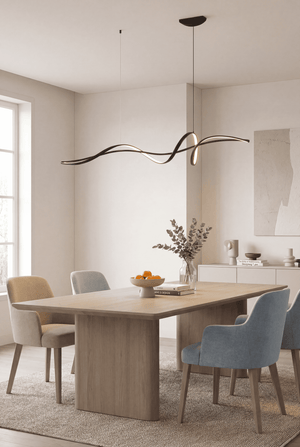
Installing a dining room pendant light is a major decorative challenge that directly affects the ambiance and functionality of your dining area. The success of this setup is based on one fundamental rule: keep the optimal height of 70 to 80 cm from the tabletop to the bottom of your light fixture.
This standardized distance guarantees a perfect balance between functional and aesthetic lighting. A pendant that’s too high spreads light inefficiently, while an installation that’s too low creates annoying shadow areas and can block diners’ view.
Lighting professionals recommend a light intensity of 250 to 300 lm/m² for a work surface like a dining table. This output ensures optimal visibility for meals while maintaining a warm ambiance.
Fundamental height rules for a pendant light
The table pendant height follows precise technical principles that vary depending on the dimensions of your space and your ceiling configuration. For a standard installation with a 2.50-meter ceiling, the recommended distance is between 70 and 80 centimeters above the tabletop.
This measurement applies to the lowest point of your light fixture, whether it’s a lampshade, a diffuser, or any other decorative element. The 160-centimeter rule is a reliable alternative: your pendant should be installed at least 1.60 meters from the floor.
For high ceilings over 3 meters, you can adjust this measurement by adding an extra 10 centimeters for every 50 centimeters of additional height. This progression helps maintain visual proportions and lighting effectiveness.
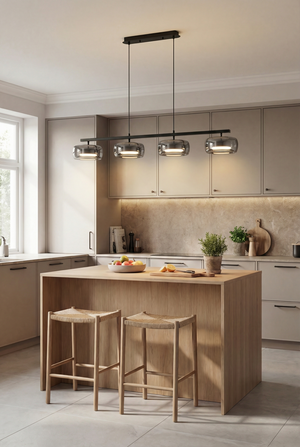
Aligned multiple pendants require specific spacing of 70 to 80 centimeters between each light fixture. This distance prevents overlapping light and creates a harmonious visual rhythm along your table.
Adjust the distance based on ceiling height
The table-to-ceiling distance directly influences the choice of your pendant light and its optimal position. A standard ceiling height of 2.40 to 2.60 meters offers comfortable leeway for most residential lighting fixtures.
For low ceilings under 2.40 metres, choose compact pendant lights with a short, adjustable cable. This setup avoids a visually cramped effect while maintaining easy movement around the table. A height of 65 to 70 centimetres then becomes more appropriate.
Spaces with cathedral or vaulted ceilings allow for bolder installations. You can opt for large pendant lights and play with varying hanging heights between 80 and 100 centimetres depending on the desired effect.
Using a compatible dimmer makes it possible to adjust light intensity throughout the day. Choose dimmable LEDs with a CRI above 90 to preserve accurate colours during meals.
Choosing the right pendant size
The diameter of your pendant light should maintain a harmonious ratio with your table’s dimensions. The general rule recommends a fixture whose diameter is between 50 and 75% of the width of your rectangular table.
For a round table, the pendant’s diameter should not exceed 12 centimetres less than your table’s. This proportion ensures even lighting without excessive light spill into adjacent areas.
Tables over 180 centimetres often require multiple light points. Choose two or three identical pendant lights spaced evenly, or opt for a linear light fixture whose length covers two thirds of your table.
The recommended wattage ranges from 15 to 25 watts in LED depending on the area to be lit. A table for 4 people (120 x 80 cm) requires about 3,000 to 4,000 lumens distributed evenly. Our collection of pendant lights offers models suited to every configuration.
Types of pendant lights based on how the table is used
The choice of your dining room pendant light varies considerably depending on your table’s primary use. A table dedicated to everyday family meals requires different lighting than a space used for occasional entertaining.
For multi-purpose use (meals, work, games), opt for pendants with an opaque shade that directs light downward. This setup concentrates lighting on the work surface with a neutral 4000K color temperature.
Spaces for entertaining and socializing are perfectly suited to pendants with omnidirectional diffusion. These models create a warm atmosphere with soft light spread throughout the room, ideally in warm white 2700K.
Pendants with an integrated dimmer offer maximum flexibility. This technology makes it possible to adjust brightness between 300 lm/m² for precise tasks and 100 lm/m² for relaxing moments. Discover our selection of wall lights to complement your general lighting.
Installation and technical adjustments
Installing your lighting height requires careful technical preparation. Check your ceiling’s load-bearing capacity, especially for pendants over 5 kilograms that require reinforced anchoring.
Electrical compatibility is a crucial aspect that is often overlooked. Make sure your installation can handle the total wattage of your LEDs, allowing for a 20% safety margin. E27 and E14 bases remain the most common for domestic pendant lights.
Wiring with a dimmer requires particular attention to the technology used. Trailing-edge dimmers are better suited to modern LEDs, while leading-edge dimmers remain suitable for traditional bulbs still in use.
For complex installations with multiple light points, bringing in a qualified electrician ensures compliance with NF C 15-100 standards. This regulation notably requires minimum safety distances and appropriate cable cross-sections.
Common mistakes to avoid
The most common mistake is to install the pendant light too high out of caution. This excessive precaution drastically reduces lighting efficiency and creates significant shadowy areas around the table.
Conversely, a pendant light that hangs too low creates unpleasant direct glare and restricts movement around the table. This setup turns meals into a tiring visual ordeal for your guests.
Choosing an unsuitable wattage is a costly technical mistake. Insufficient lighting forces you to add additional light sources, while excessive lighting creates a cold, unwelcoming atmosphere.
The lack of a dimmer or dimming greatly limits the versatility of your setup. This feature makes it possible to adjust the lighting to different times and uses in your dining room. Explore our floor lamps to create complementary ambient lighting.
Matching the room’s style
The aesthetic integration of your pendant light depends on its consistency with the existing furniture. A solid-wood table naturally pairs with pendant lights made from premium materials such as brass, copper, or crafted wood.
Contemporary interiors favor clean lines and modern materials such as brushed aluminum or frosted glass. These choices create visual continuity with architectural elements and modern kitchen fittings.
For industrial-style spaces, choose metal pendant lights with raw or patinated finishes. These fixtures pair perfectly with metal and raw-wood tables, creating an authentic, warm atmosphere.
The light color directly affects the perceived atmosphere. A high CRI of 90 or more preserves the true colors of food and the materials of your furniture. Our range of chandeliers offers solutions suited to every decorative style.
Supplementary lighting and ambience
A single central pendant light is generally not enough to create perfect lighting in your dining room. Adding peripheral light sources enriches the atmosphere and improves overall visual comfort.
Wall sconces installed 1.70-1.80 meters from the floor create soothing indirect lighting. This setup reduces harsh contrasts and offers an alternative for relaxed evenings without the main light on.
Adding table lamps on a sideboard or console brings an extra decorative dimension. These elements create pools of soft light that enhance the room’s overall atmosphere.
For large dining rooms, consider installing recessed spotlights or lighting tracks around the perimeter. This solution provides even general lighting that perfectly complements your central pendant light. Discover our collection of ceiling lights for elegant general-lighting solutions.
What is the ideal height for a pendant light above a 6-person table?
For a 6-person table, typically 180 x 90 cm, install your pendant light 75-80 cm above the tabletop. This distance ensures even lighting across the entire surface without bothering guests. Plan for 25-30 watts in LED with a luminous flux of 4,000 to 5,000 lumens.
How do you adapt the height with a 3-meter ceiling?
With a 3-meter ceiling, you can install your pendant light 85-90 cm above the table. This extra height preserves visual proportions and allows you to use larger fixtures. Keep the rule of a minimum of 1.70 meters from the floor to avoid any risk of collision.
Should you adjust the height based on the guests’ height?
The standard height of 75-80 cm suits 95% of users with no adjustment needed. Tall people (over 1.90 m) may benefit from an installation up to 85 cm. Avoid settings below 70 cm, which create unpleasant direct glare for everyone at the table.
What distance should you keep between several aligned pendant lights?
For multiple pendant lights, keep a 70 to 80 cm spacing between the centers of each fixture. This distance prevents light overlap and creates a harmonious visual rhythm. Over a 240 cm table, three 30 cm-diameter pendants spaced 75 cm apart provide perfectly balanced lighting.