

Color Rendering Index (CRI): Complete Guide to Choosing Your Light Fixtures
The color rendering index is a fundamental criterion when choosing your luminaires. This technical value determines the ability of your lighting to faithfully reproduce the natural colors of objects, textiles, and your interior décor. Understanding this indicator will help you create a lighting atmosphere perfectly suited to each area of your home.
For design-lighting enthusiasts and those seeking exceptional light quality, understanding CRI becomes essential. This measure directly influences the atmosphere of your rooms and the visual perception of your furniture and artworks. Poorly chosen lighting can turn a warm living room into a dull, characterless space.
What is the CRI color rendering index?
CRI, or Color Rendering Index in English, measures the accuracy of color rendering of an artificial light source compared with natural sunlight. This value is expressed on a scale from 0 to 100, where 100 represents perfect rendering equivalent to direct sunlight.
CRI is calculated by comparing the appearance of fourteen reference colors under the tested light source and under a reference illuminant. These colors include pastel and saturated hues, as well as skin tones specifically selected for how representative they are in our everyday environment.
This technical measure is critically important for modern LED luminaires. Unlike old incandescent bulbs, which naturally offered a CRI close to 100, LED technologies can show significant variations depending on their design and manufacturing quality.
Lighting professionals distinguish several CRI categories depending on the application. A CRI above 90 indicates excellent lighting, while a CRI from 80 to 89 remains suitable for most domestic uses. Below 80, the quality of color rendering becomes insufficient for living spaces.
CRI 80 vs CRI 90: Understanding the differences
The difference between a CRI 80 and a CRI 90 may seem minor on paper, but it proves noticeable to the naked eye in everyday life. Lighting with a CRI of 80 renders the main colors correctly, while showing some shifts in subtle shades and mid-tones.
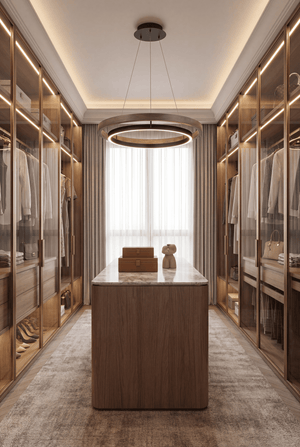
With a CRI of 90, you get remarkable color reproduction that reveals the finest chromatic details. This quality is especially valuable in a living room where you display paintings, in a kitchen where you prepare meals, or in a walk-in closet where you coordinate your outfits.
Light fixtures with a high CRI of 90 or more make it possible to precisely distinguish different shades of red—essential for appreciating the quality of meat or the ripeness of fruit. This feature explains why butchers and restaurateurs invest in lighting with a CRI above 90.
In terms of price, LEDs with a CRI 90 generally cost 15 to 30% more than their CRI 80 equivalents. This price difference is justified by the more sophisticated technology required to reach this level of color performance. Our designer pendant lights use high-quality LEDs to ensure optimal rendering.
Recommended applications by CRI
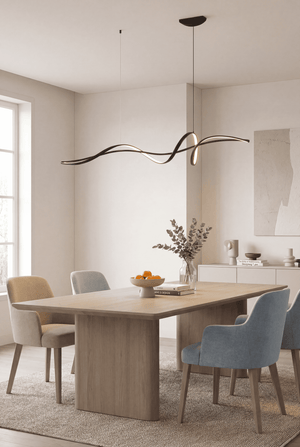
For your kitchen and dining room, choose a minimum CRI of 90 so you can fully appreciate the presentation of your dishes and the friendly atmosphere of your meals. This requirement also applies to hands-on workspaces such as a workshop or an office where you handle colored documents.
In a living room, a CRI of 80 to 85 is generally enough to create a warm, comfortable ambiance. This value helps preserve the authenticity of your décor without requiring the extra investment of a CRI 90. Your living room floor lamps can thus offer an excellent balance of quality and price.
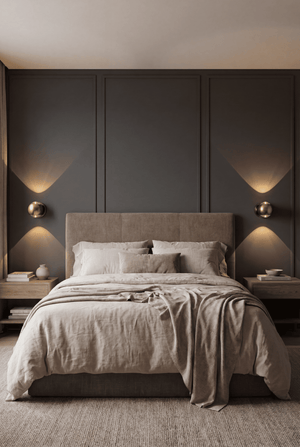
For bedrooms, a CRI of 80 is perfectly suitable because lighting there is mainly used for relaxation and rest. The emphasis should be more on color temperature, ideally between 2700K and 3000K to help you fall asleep.
Light quality and LED color rendering
The light quality of an LED light fixture is not limited to CRI alone. It also includes luminous flux stability, the absence of flicker, color temperature, and lighting uniformity. These parameters work together to create a pleasant, functional lighting environment.
Modern LED colour rendering benefits from significant technological advances. Manufacturers now use higher-quality phosphors to improve the conversion of the blue light emitted by the LED chip into a full light spectrum. This evolution makes it possible to reach CRI values of 95 or more on high-end models.
COB (Chip On Board) technology generally offers better colour rendering than traditional SMD LEDs. This integrated design reduces colour temperature variations and improves beam uniformity. Our designer wall sconces use this technology to guarantee even lighting.
The beam angle also influences colour perception. A narrow 30-degree angle concentrates light intensity and can enhance colour saturation, while a wide 120-degree angle spreads the light while preserving the natural look of hues. This consideration guides the choice between accent lighting and general lighting.
Impact of colour temperature
Colour temperature, expressed in Kelvin, interacts directly with CRI to define the final perception of colours. Warm white lighting at 2700K with a CRI of 90 reveals colours differently than neutral white lighting at 4000K at the same CRI.
Warm tones enhance warm colours such as red, orange, and yellow while slightly muting blues and greens. This characteristic explains why restaurants favour lighting at 2700K-3000K to highlight their dishes and create a welcoming atmosphere.
Conversely, cool white lighting from 5000K to 6500K with a high CRI reveals shades of blue and green perfectly, ideal for workspaces that require precise colour discrimination. This temperature is particularly suitable for creative studios and offices.
Choosing CRI for each room
Each area of your home has specific CRI requirements depending on its use and functions. This differentiated approach lets you optimize your lighting investment while ensuring visual comfort suited to each activity.
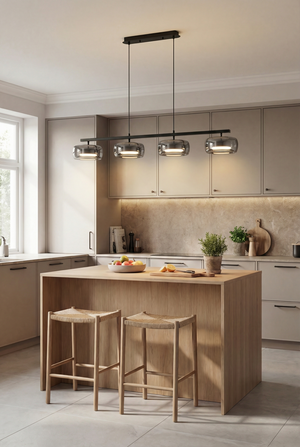
In the kitchen, CRI is critically important because you prepare and present food there. A minimum CRI of 90 is essential above the worktop and the kitchen island. This requirement helps you assess the freshness of ingredients, judge doneness, and create attractive presentations.
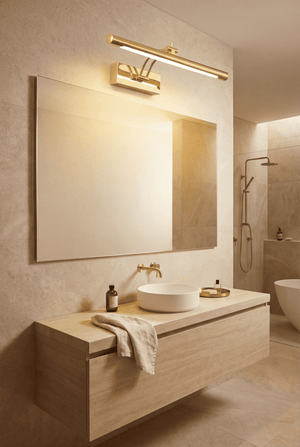
For the bathroom, a CRI of 85 to 90 ensures faithful rendering of your complexion when applying makeup or shaving. This value prevents unpleasant surprises once you are under natural light. Also make sure to comply with the minimum IP44 protection rating for zone 2 around the washbasin.
Living room and reception areas
In the living room, a CRI of 80 to 85 creates a warm and natural atmosphere without requiring maximum investment. This value preserves the authenticity of the colours in your décor, your artworks, and your upholstery textiles while maintaining a relaxed ambience.
To showcase an art collection or valuable objects, consider accent luminaires with CRI 90+ aimed specifically at these elements. This mixed approach optimises the lighting budget by focusing high colour quality on the areas that benefit from it most. Our living room chandeliers can incorporate this advanced technology.
Indirect lighting with LED strips or coves can make do with a CRI of 80, as it mainly contributes to the overall ambience rather than to precise colour assessment. This distinction helps keep costs under control without compromising the desired decorative effect.
Office and workspaces
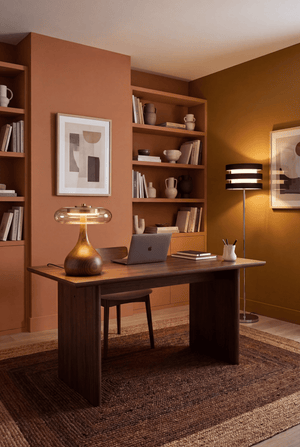
An office requires a CRI of 85 to 90 depending on the nature of the activities carried out. Jobs involving colour handling, such as graphic design or interior decoration, require a minimum CRI of 90 to ensure the accuracy of the work produced.
Office lighting must also avoid glare and reflections on screens. Choose luminaires with anti-glare optics with UGR below 19 and an even light distribution of at least 500 lux on the work surface. Our designer desk lamps meet these ergonomic criteria.
CRI standards and certifications
The CRI is governed by strict international standards that ensure the reliability of measurements and comparability between manufacturers. The CIE 13.3 standard defines the official calculation method used worldwide to determine the colour rendering index of light sources.
This standard requires the use of fourteen specific test colours numbered from R1 to R14. The first eight colours (R1 to R8) are used to calculate the general CRI, while the next six (R9 to R14) are used to assess the rendering of saturated colours, notably the deep red R9, which is crucial for food lighting.
Reputable manufacturers consistently state the CRI on the technical datasheets for their LEDs. Be wary of products without this information or with roughly rounded values. A CRI stated as exactly 80 or 90 with no decimal place may hide a lower real value.
Some labels such as Energy Star or LM-79 require rigorous CRI testing and tighter tolerances. These certifications ensure that the stated value truly matches performance measured in an independent laboratory.
Evolution and limitations of CRI
The traditional CRI index has certain recognized technical limitations among lighting professionals. Its calculation method, developed in the 1960s, does not perfectly reflect modern human color perception, especially for LED sources.
New complementary indices are emerging, such as TM-30 or the IES Method, which evaluate color rendering across a broader spectrum of 99 colors. These advanced metrics offer a more nuanced view of light quality, particularly relevant for demanding applications.
The R9 index, which specifically measures saturated red rendering, is gaining importance because it directly influences perception of skin tone and food. A general CRI of 80 can hide a poor R9 of 50, creating dull reds despite an acceptable overall value.
Impact on visual comfort and health
Lighting with a suitable CRI contributes significantly to everyday visual comfort and can influence your overall well-being. Research in chronobiology shows that the spectral quality of light affects circadian regulation and melatonin production.
Poor color rendering can cause premature visual fatigue, especially during prolonged activities requiring fine color discrimination. This fatigue shows up as eye strain, headaches, and reduced concentration.
In workspaces, an insufficient CRI reduces efficiency and can lead to errors in color judgment. This issue particularly affects medical, artistic, and technical professions where color accuracy determines the quality of the work performed.
High-CRI home lighting also improves food safety by making it possible to visually detect food freshness and storage condition. This ability to assess visually complements the other senses to ensure a healthy diet.
Economic considerations
Investing in high-CRI luminaires is justified by their durability and their impact on increasing your home’s value. Designer luminaires with excellent color rendering are a valued selling point when reselling property.
The higher upfront cost of high-quality CRI 90+ LEDs pays off over their 25,000 to 50,000-hour lifespan. This exceptional longevity, combined with optimized energy consumption, generates substantial savings compared with traditional lighting solutions.
Premium manufacturers often offer extended warranties of 3 to 5 years on their high-CRI luminaires, showing their confidence in the durability of their products. This contractual protection safeguards your investment and ensures performance is maintained over time.
Frequently asked questions about the color rendering index
Which CRI to choose for a 25 m² living room
For a 25 m² living room, choose a minimum CRI of 85 for general lighting, i.e., about 2,500 to 3,750 lumens distributed evenly. Add CRI 90+ accent light points to highlight your artwork or decorative objects. This setup offers an excellent balance between visual comfort and a reasonable investment.
Is a CRI of 80 enough for a modern kitchen
A CRI of 80 is still insufficient for a kitchen where you prepare meals every day. Aim for a minimum CRI of 90 above the countertop and the central island, with at least 500 lux of illuminance. This setup ensures an accurate assessment of food freshness and optimal cooking. General lighting can make do with a CRI of 85.
How to check the real CRI of my existing luminaires
To check the CRI of your luminaires, consult their original datasheets or the bulb labeling. Reputable manufacturers always state this value. If the information is missing, contact the manufacturer’s customer service directly with the exact product reference. Be wary of approximate values or vague claims like "high-quality light" with no precise figures.
Does the CRI degrade over time in LEDs
The CRI of quality LEDs remains generally stable during the first 5 years of normal use. However, some phosphors can undergo gradual degradation, especially in low-end LEDs exposed to high temperatures. Choose luminaires with effective thermal management and an extended manufacturer warranty to preserve color performance over time.