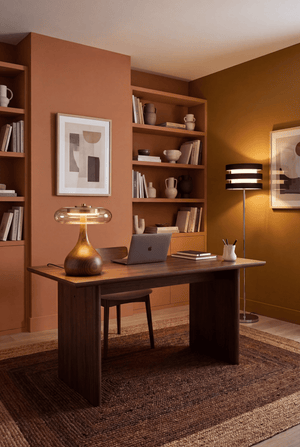
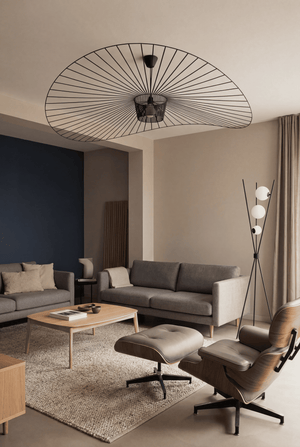
Lighting trends 2024: 7 essential design styles
The world of designer lighting is experiencing a remarkable evolution in 2024, driven by aesthetic and technical innovations that are radically transforming our living spaces. Decoration professionals identify seven major trends dominating the contemporary lighting market, each bringing its own philosophy and specific visual codes.
These new stylistic directions reflect a quest for authenticity and well-being, where the quality of light becomes as important as the lighting object itself. The evolution of LED technologies, now reaching lifespans of 50,000 hours, allows designers to explore new forms while meeting contemporary energy requirements.
Architectural minimalism: purity and lighting performance
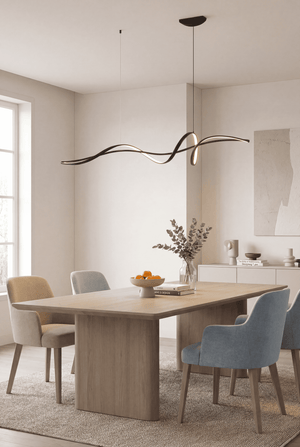
The minimalist style asserts its supremacy in 2024 with creations that prioritize lighting efficiency without aesthetic compromise. This trend is characterized by luminaires with perfect geometries, using noble materials such as anodized aluminum, optical glass, and technical composites.
Minimalist designer pendants now incorporate advanced dimming systems, allowing precise adjustment of light intensity between 10 and 100% without flicker. These luminaires generally deliver between 800 and 1200 lumens for a 20m² living room, with a color temperature adjustable from 2700K to 4000K depending on the time of day.
Designers favor ultra-thin profiles, often less than 2 centimeters thick, that seem to float in space. The beam angles are expertly calculated: 60 degrees for general lighting, 30 degrees for reading areas, allowing optimal light distribution without glare.
Materials and finishes of contemporary minimalism
The year 2024 sees the emergence of new surface treatments that reinforce the minimalist identity. Matte finishes largely dominate, with reflectance indices carefully controlled to avoid unwanted reflections. Deep black sits alongside pure white, while beige and greige tones bring a welcome softness.
Lamp bases are becoming standardized around E27 and GU10 formats to facilitate maintenance, with a marked preference for integrated LED sources that ensure photometric consistency throughout the luminaire's lifespan.
Vintage renaissance: Art Deco revisited by modern technology
The 2024 vintage trend transcends mere nostalgia to offer a contemporary reinterpretation of the great classics of lighting design. This approach combines the aesthetic authenticity of past eras with today's technical performance.
Contemporary vintage chandeliers retain the visual codes of the 1920s to 1970s while incorporating high-performance LED sources. A modern Art Deco chandelier can thus produce 3000 lumens with only 35 watts of consumption, compared to 300 watts for its period counterpart equipped with incandescent bulbs.
Brushed brass and patinated copper finishes are enjoying remarkable success, particularly appreciated for their exceptional color rendering with a CRI above 95. These noble materials develop a natural patina that enriches their character over time.
Chic industrial: when the factory inspires the living room
Industrial aesthetics are becoming more refined in 2024 with lighting fixtures that retain the visual robustness of the factory style while offering impeccable lighting comfort. Modern industrial wall lights feature sophisticated optics that eliminate direct glare while preserving the authenticity of the design.
Installation heights are becoming standardized: 1.75m for hallway wall lights, at least 2.10m for pendants above a passageway, ensuring both safety and lighting efficiency.
Scandinavian elegance: hygge and energy performance
Scandinavian design is evolving in 2024 towards an even more refined approach to visual comfort and energy efficiency. This trend favors organic shapes and noble natural materials such as solid oak, beech, and birch, carefully selected for their dimensional stability.
Modern Scandinavian lighting fixtures excel at diffusing soft light, with technical fabric lampshades that filter harmful rays while preserving exceptional color rendering. The preferred color temperature ranges between 2700K and 3000K, creating that warm ambiance characteristic of Nordic hygge.
Scandinavian table lamps now feature ultra-sensitive touch dimmers that allow intuitive adjustment of brightness. These systems offer a dimming range from 5 to 100%, with memory of the last used intensity.
Wood and technology: the perfect alliance
The major innovation of 2024 lies in the harmonious integration of technology into entirely natural structures. Designers are developing invisible mounting systems that preserve the purity of the lines while ensuring safe installation.
Local woods are favored, with traceability marking that guarantees responsible forest management. This eco-friendly approach appeals to a clientele increasingly sensitive to environmental issues.
Authentic materials: back to natural sources
The trend for natural materials is emerging as one of the most defining directions of 2024. This approach meets a deep need for reconnection with nature, especially pronounced after recent periods of lockdown.
Rattan and bamboo are experiencing a remarkable technical renaissance. New treatments allow for ultra-precise weaving that creates play of shadow and light with rare sophistication. These materials also offer excellent diffusion properties, with an optimized light transmission coefficient.
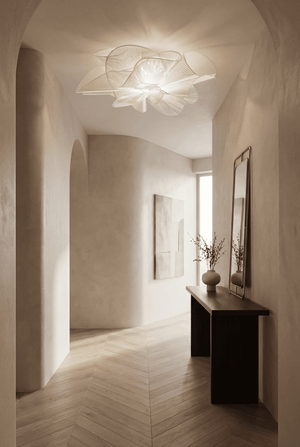
Modern ceiling lights in natural materials feature reinforced mounting systems that ensure maximum safety despite the apparent lightness of these organic structures. The maximum supported load generally reaches 15 to 20 kilograms depending on the model.
Technical linen and cotton: textile and lighting
Textile lampshades are evolving towards technical fibers that combine lighting performance and durability. These new materials are UV-resistant, limit dust accumulation, and retain their optical properties for over 10 years of normal use.
Textures are diversifying: coarse linen for a chic rustic style, bouclé cotton for a cozy atmosphere, natural hemp for zen spaces. Each material offers its own unique luminous signature, with perfectly controlled levels of diffusion.
Bold colors: the art of functional color
The year 2024 marks the strong return of color in the world of lighting, but with a thoughtful approach that goes beyond mere visual appeal. Functional colors are becoming tools for well-being and space optimization.
Cobalt blue, particularly popular, positively influences concentration and reduces visual stress. Recent studies show that this shade improves cognitive performance by an average of 15% when used in home workspaces.
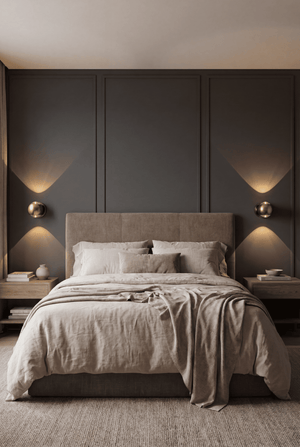
Emerald green creates a soothing environment that promotes rest and recovery. Colored floor lamps in these tones become therapeutic as well as decorative elements, especially appreciated in bedrooms and relaxation areas.
Color psychology and lighting
Research in chronobiology confirms the impact of ambient colors on our circadian rhythms. Salmon pink stimulates serotonin production in the evening, promoting sleep, while mustard yellow naturally energizes daytime living spaces.
This scientific approach to color now guides the choices of professional decorators, who favor lighting fixtures capable of adapting their chromatic rendering according to the time of day and the activities being performed.
Smart lighting: home automation and design converge
The integration of smart technologies is radically transforming the user experience of lighting fixtures in 2024. Home automation systems no longer just turn lights on and off: they create truly personalized lighting scenarios that adapt to lifestyle habits.
Next-generation presence sensors not only detect movement but also analyze the activity being performed. A sensor installed in a living room can distinguish between reading, working on a screen, or relaxing, and automatically adjust the intensity and color temperature accordingly.
This technology comes with a sleek aesthetic where electronic components become invisible. Connected lighting fixtures retain their formal purity while offering advanced features accessible via smartphone or voice control.
Energy savings and optimized comfort
Smart lighting fixtures generate substantial energy savings: up to 60% reduction in consumption compared to conventional lighting, thanks to automatic intensity management based on ambient brightness and occupant presence.
This energy performance is accompanied by unmatched visual comfort, with gradual light transitions that respect eye physiology and prevent visual fatigue.
Emerging trends: towards the lighting of tomorrow
Several emerging trends are already shaping the future of home lighting. Biodynamic lighting faithfully reproduces the natural variations of sunlight, with LEDs capable of changing their light spectrum throughout the day.
Recycled materials are gaining ground, with fixtures made from recovered ocean plastics or metals from the circular economy. This eco-friendly approach does not compromise on aesthetic or technical quality.
3D printing is also revolutionizing the creation of custom lighting fixtures, allowing for complex shapes that are impossible to achieve with traditional techniques. This technology opens up endless possibilities for customization and adaptation to specific architectural constraints.
What LED wattage should you choose to replace a 60W incandescent bulb?
An 8 to 10 watt LED produces the same light output (about 800 lumens) as a 60W incandescent bulb, while consuming 85% less energy. Opt for a CRI above 90 for optimal color rendering in living spaces.
At what height should a pendant light be installed above a dining table?
The ideal distance between the tabletop and the bottom of the pendant light is 70 to 80 cm. This height ensures effective lighting without glare, with even light distribution across the entire dining surface.
How do you choose the color temperature according to the room?
Choose 2700K to 3000K (warm white) in bedrooms and living rooms to create a cozy atmosphere, 4000K (neutral white) in kitchens and offices to promote concentration, and 5000K to 6500K (cool white) in garages and workshops for optimal technical lighting.
What is the average lifespan of high-end LED fixtures?
Premium LED fixtures offer a lifespan of 25,000 to 50,000 hours, or 15 to 25 years of use at 5 hours per day. This exceptional longevity more than offsets the initial investment and significantly reduces maintenance costs.