
Lumens per square meter: calculate the ideal lighting for each room
Optimal interior lighting is based on a fundamental figure: the number of lumens per square metre needed for each activity. This measure determines visual comfort, ambience, and the efficiency of your living spaces. Understanding it will help you design lighting perfectly suited to every room in your home.
Accurately calculating lighting needs helps avoid common mistakes: under-lit areas that cause eye strain, or overlighting that leads to excessive energy consumption. Each space has its own requirements, depending on its use and dimensions.
Understanding lighting measurement units
The lumen (lm) quantifies the total luminous flux emitted by a source. Unlike the watt, which measures electrical consumption, the lumen indicates the amount of light produced. This distinction is crucial with the rise of LED technology, where a 10W bulb can produce as many lumens as an older 60W bulb.
Lux measures the illuminance received on a given surface. It corresponds to the number of lumens per square metre (lm/m²). This unit makes it possible to quantify precisely the perceived light intensity in a space. For example, a desk needs at least 500 lux for comfortable work.
CRI (Colour Rendering Index) complements these measurements by assessing colour accuracy under a given light. A CRI above 80 suits living areas, while a CRI of 90 or higher is recommended for precision work areas such as kitchens or offices.
Standards and recommendations by room type
Living room and relaxation areas
The living room needs flexible, adjustable lighting suited to its many functions. For general lighting, plan for 100 to 150 lumens per square metre. This baseline provides optimal visual comfort for reading, conversation, or watching TV.
Accent lighting rounds out this base with targeted spot sources of 200 to 300 lumens per square metre in the areas concerned. Reading corners need a local boost reaching 500 lumens per square metre.
Choose a warm white 2700K to 3000K colour temperature to create a cosy atmosphere. Dimmable light fittings let you adjust the brightness depending on the time of day.
Kitchen and food prep areas
The kitchen requires the highest lighting level in the home. Worktops need between 250 and 300 lumens per square meter to ensure safety and precision during food preparation.
General kitchen lighting is between 200 and 280 lumens per square meter. This intensity ensures perfect visibility in every corner, avoiding dangerous shadowy areas near cooking appliances.
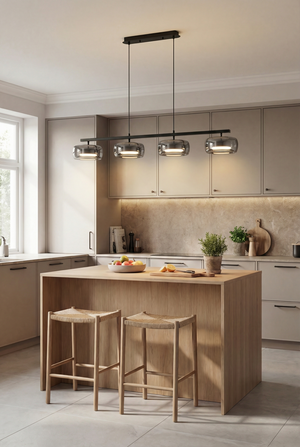
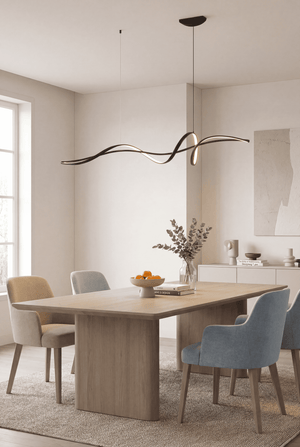
Go for a neutral white 4000K that faithfully renders the colors of food. A minimum CRI of 90 is required to clearly distinguish product freshness. Our designer pendant lights offer elegant solutions for lighting central islands.
Bedrooms and rest areas
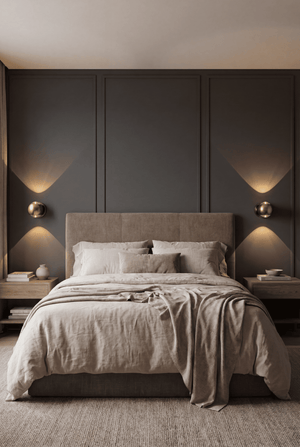
The bedroom favors gentle lighting with 50 to 100 lumens per square meter for general lighting. This moderate intensity promotes relaxation and prepares you for sleep.
Reading areas require localized reinforcement reaching 300 lumens per square meter. Position these sources at least 1.20 m from the reading point to avoid direct glare.
Choose only a very warm white 2700K so as not to disrupt melatonin production. Dimmers help create a subdued evening atmosphere.
Methods for calculating optimal lighting
Basic calculation by area
The fundamental method multiplies the area in square meters by the recommended lumens depending on use. For a 20 m² living room requiring 150 lm/m², the total need comes to 3000 lumens.
This value is then distributed among several light sources. A central ceiling light can provide 60% of the total (1800 lm), complemented by auxiliary sources (1200 lm) spread throughout the space.
Watch out for loss coefficients related to reflectors, diffusers, and bulb wear. Increase your calculations by 20% to compensate for these variations over time.
Cavity method
This professional approach incorporates the room’s actual dimensions: ceiling height, surface color, and furniture layout. It calculates reflection coefficients to optimize lighting efficiency.
Light-colored surfaces (white, beige) reflect 70 to 80% of the light they receive, reducing the need for primary sources. Conversely, dark colors absorb up to 90% of the luminous flux, requiring a significant boost.
Ceiling height directly affects perceived lighting. Beyond 3 metres in height, increase requirements by 30% to compensate for the distance between the source and the working plane.
Lighting technologies and luminous efficacy
LEDs: performance and longevity
LEDs offer the best luminous efficacy at 80 to 120 lumens per watt versus 10 to 15 for incandescent bulbs. This performance drastically reduces energy consumption while increasing lifespan to 25,000 to 50,000 hours.
SMD (Surface Mounted Device) and COB (Chip On Board) technologies provide uniform distribution of the light output. SMD chips suit directional lighting, while COB excels at diffuse lighting.
Compatibility with electronic dimmers (trailing edge) improves everyday comfort. Check this feature before buying, as not all LEDs support dimming.
Beam angles and placement
The beam angle determines how light is distributed in a space. A 30-degree beam angle is suitable for accent lighting, focusing the output on a specific area.
For general lighting, choose beam angles of 60 to 120 degrees that spread light evenly. This distribution prevents excessive contrast between lit areas and cast shadows.
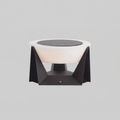
Our designer ceiling lights feature sophisticated optics to optimise light distribution according to the needs of each space.
Optimising lighting to match how each space is used
Walkways and circulation
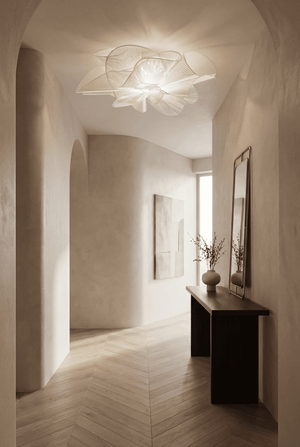
Corridors, staircases, and entrances require safety lighting of 50 to 100 lumens per square metre. This level ensures safe movement without glare or dangerous shadowy areas.
Choose uniform lighting that avoids harsh contrasts with adjacent rooms. Wall sconces positioned 1.70–1.80 m from the floor provide optimal distribution.
Installing motion sensors reduces energy consumption while ensuring automatic lighting during night-time passage.
Workspaces and concentration
Offices require at least 500 lumens per square metre to prevent eye strain during prolonged reading. This level rises to 800 lm/m² for precision work or handling thin documents.
Avoid direct lighting on computer screens, which creates distracting reflections. Position light sources to the side or use indirect lighting reflected off light-colored surfaces.
A neutral white 4000K helps maintain focus and reduces daytime drowsiness. Add supplementary warm-white lighting for relaxation moments.
Common mistakes and practical solutions
Under-lighting and visual fatigue
Under-lighting is the most common mistake, especially in kitchens and offices. This shortfall causes premature eye strain and reduces the efficiency of precise tasks.
Symptoms include: headaches at the end of the day, difficulty making out details, and the need to move closer to objects to see clearly. These signs indicate insufficient lighting that should be corrected quickly.
The solution is to precisely measure the existing lighting with a professional lux meter, then add the necessary sources to reach the recommended values.
Poor light distribution
Only central lighting creates large shadow areas in corners and behind furniture. This uneven distribution reduces visual comfort and the functionality of the spaces.
Multiply light sources by combining general, accent, and task lighting. This layered approach ensures optimal comfort for all activities.
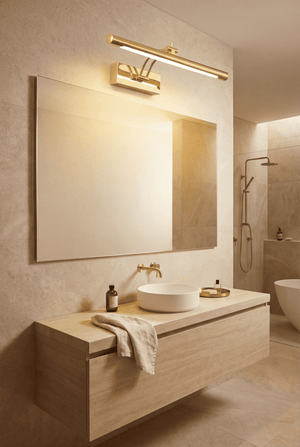
Our wall lights make it easy to effectively complement central lighting while adding a sophisticated decorative touch.
Installation and practical implementation
Recommended mounting heights
Pendant lights above tables should be positioned 70–80cm above the tabletop for optimal lighting without visual discomfort. This distance ensures even distribution across the entire surface.
For general lighting, maintain a minimum clear height of 2.10m between the floor and the lowest point of the fixture. This rule avoids collision risks while optimizing light distribution.
Wall lights are ideally installed between 1.70m and 1.80m above the floor for comfortable face lighting without direct glare in the eyes.
Electrical standards and safety
Follow the IP protection ratings according to the installation areas. Dry indoor areas require a minimum IP20 rating, while bathrooms require IP44 in zone 2 and IP65 near water points.
Lighting circuits are protected by 10A circuit breakers in standard home installations. Each circuit can supply up to 8 lighting points with 1.5 mm² cable.
Installing dimmers requires verified compatibility with the bulbs used. Dimmable LEDs require specific electronic dimmers to prevent flickering.
Maintenance and optimization over time
LED bulbs gradually lose their light output over the years. Expect a 20% drop after 20,000 hours of use, requiring replacement to maintain the original comfort level.
Regular cleaning of light fixtures and reflectors significantly improves efficiency. Accumulated dust can reduce the amount of light dispersed in the room by 30%.
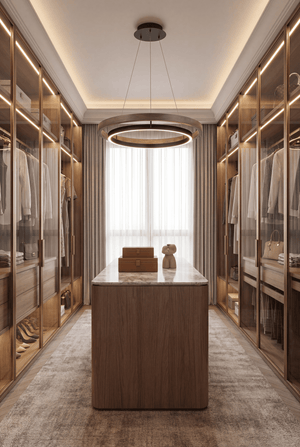
Our high-end chandeliers feature easy-clean systems and the latest-generation LEDs for long-lasting performance.
Frequently asked questions
How many lumens to light a 15m² room?
For a 15m² room, needs vary by use: 1500 to 2250 lumens for a living room (100-150 lm/m²), 3000 to 4200 lumens for a kitchen (200-280 lm/m²), or 750 to 1500 lumens for a bedroom (50-100 lm/m²). Distribute this total across multiple sources for even lighting.
How do you accurately calculate the lighting needed for an office?
An office needs at least 500 lumens per square meter. So for a 10m² office, plan for at least 5000 lumens. Add an extra 300 lm/m² on the direct work surface. Choose a neutral white 4000K and a CRI above 90 to reduce eye strain.
What’s the difference between 2700K and 4000K for home lighting?
2700K produces a warm white light that’s ideal for relaxation areas (living room, bedroom), creating a cozy atmosphere. 4000K provides a neutral white that’s perfect for work areas (kitchen, office), helping you stay focused and rendering colors accurately.
How do you distribute 3000 lumens in a 20m² living room?
Break it down according to the 60/30/10 rule: 1800 lumens for general lighting (ceiling light or central pendant), 900 lumens for ambient lighting (wall sconces), and 300 lumens for accent lighting (auxiliary lamps). This split ensures optimal comfort for all living-room activities.