
Recessed or surface-mounted spotlight: how to make the right choice for your interior
The choice between a recessed spotlight and a traditional ceiling light is a crucial decision when planning your indoor lighting. This selection affects not only the aesthetics of your spaces, but also their lighting functionality and your day-to-day comfort.
Each ceiling lighting solution has specific technical characteristics that determine how well it suits your needs. Understanding these differences will help you optimize the lighting in each room while respecting your architectural constraints and your budget.
Technical specifications of recessed LED spotlights
Recessed LED spotlights fit directly into the ceiling structure, leaving only their light-emitting surface visible. This technology requires a minimum ceiling void height of 8 to 12 cm depending on the model chosen, to accommodate the housing and ensure adequate ventilation.
The power of recessed spotlights generally ranges between 3 and 12 watts, producing a luminous flux of 250 to 1000 lumens. Their standard 60-degree beam angle is perfectly suited to general lighting, while 30-degree models create more precise accent beams.
The color temperature of integrated LEDs ranges from warm white at 2700K for cozy atmospheres to neutral white at 4000K for work spaces. The color rendering index (CRI) generally reaches 80 to 90, ensuring accurate color reproduction.
Adjustable models offer a tilt of up to 30 degrees, allowing you to direct the light to suit your specific needs. The most common bases are GU10 for standard models, as well as integrated, non-replaceable versions with a lifespan of 25,000 to 50,000 hours.
Advantages and performance of ceiling lights
Living room ceiling lights and other fixtures offer a different approach to lighting, favoring wide, even distribution. Their installation requires no ceiling cutouts, which is a major advantage for rental homes or complex ceilings.
The power of modern LED ceiling lights ranges from 20 to 100 watts, generating a luminous flux of 2,000 to 10,000 lumens depending on the area to be lit. This capability allows them to effectively illuminate large surfaces with a single central light point.
Ceiling lights often incorporate dimming systems compatible with trailing-edge or leading-edge dimmers. This feature makes it possible to adjust lighting to different times of day, creating adjustable atmospheres from 10% to 100% of the rated output.
Their 120-degree beam angle or more ensures an even distribution of light across the entire room. Recent models offer variable color temperatures, shifting from warm white to cool white depending on programming or user preferences.
Selection criteria by space
The choice between spotlights and a ceiling light mainly depends on your room layout and your specific lighting needs. Large spaces generally benefit from the general lighting provided by ceiling lights, while areas that require targeted lighting are better served by recessed spotlights.
For a 25 m² living room, a ceiling light of 60 watts producing 6000 lumens provides optimal general lighting, i.e., 240 lm/m². This setup meets the recommendations of 100 to 300 lm/m² for living spaces. Adding supplementary spotlights makes it possible to create functional lighting zones.
Modern kitchens often adopt a combination of solutions: 7-watt recessed spotlights above the worktop to reach 300 lm/m², complemented by a central ceiling light for ambient lighting. This layered approach optimizes visual comfort and functionality.
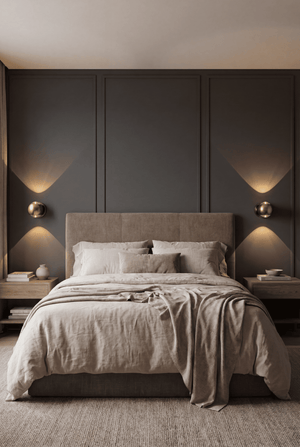
In bedrooms, dimmable recessed spotlights offer welcome flexibility, enabling bright light for activities (reading, getting dressed) and a subdued atmosphere for relaxation. The recommended output ranges between 50 and 100 lm/m² depending on use.
Installation and technical constraints
Installing recessed LED spotlights requires specific ceiling preparation and the involvement of a qualified electrician. Precise ceiling cut-outs, generally 65 to 100 mm in diameter depending on the model, require suitable tools and prior identification of load-bearing structures.
Ceiling height constraints are a key factor: plasterboard suspended ceilings must have at least 8 cm of service void, while concrete ceilings require specific junction boxes. Spotlight ventilation is crucial to maintain their optimal performance and lifespan.
Ceiling lights offer simplified installation, requiring only the mounting of a bracket to the ceiling and the electrical connection. This solution is perfectly suited to renovations without major work, with reduced installation time and controlled costs.
Maintenance also differs: recessed spotlights with integrated LEDs require complete fixture replacement at end of life, while ceiling lights often allow simple replacement of the light sources. This consideration affects the total cost of ownership over the long term.
Energy performance and durability
Energy consumption is a key criterion when choosing between these two technologies. 7-watt recessed LED spotlights effectively replace 50-watt halogens, delivering an 85% energy saving for an equivalent luminous flux.
Modern LED ceiling lights achieve efficacies of 100 to 150 lm/W, placing this technology among the best-performing on the market. Their optimised thermal management, thanks to the diffuser volume, helps maintain this efficiency throughout the nominal lifespan of 50,000 hours.
SMD (Surface Mounted Device) technology used in recessed spotlights ensures stable colour temperature and light intensity over time. Colour variations remain below 100K over 25,000 hours of use, preserving the visual consistency of the installation.
The IP protection rating varies depending on the application: standard recessed spotlights have an IP20 rating for dry indoor areas, while bathroom versions reach IP44 in zone 2. Ceiling lights generally offer better protection thanks to their enclosed housing.
Aesthetic aspects and decorative integration
The visual impact is a key factor when choosing between spotlights and ceiling lights. Recessed spotlights create a modern, streamlined "starry sky" effect, particularly popular in contemporary interiors. Their architectural discretion preserves the clean lines of the ceiling.
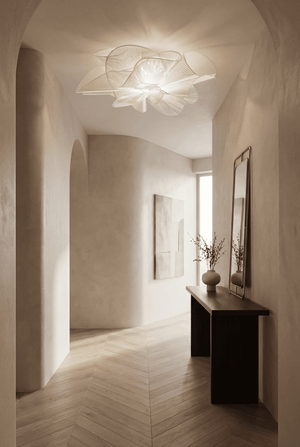
Ceiling lights stand out as fully fledged decorative elements, available in a variety of styles from minimalist design to more ornate creations. This visibility makes it possible to create a decorative focal point while ensuring the main lighting function.
Our collection of designer ceiling lights offers models that combine technical performance with refined aesthetics. Finishes range from brushed metal to frosted glass, suited to contemporary and traditional decorative styles.
The modularity of recessed spotlights makes it possible to create customized lighting layouts: geometric alignments, staggered patterns, or asymmetrical arrangements depending on the room’s architecture. This flexibility is especially valuable for unusual spaces or multi-level ceilings.
Investment cost and return on investment
The initial budget varies significantly depending on the solution chosen. Quality recessed LED spotlights range from €25 to €80 per unit depending on power and features. Professional installation generally adds €30 to €50 per light point, including cut-out and wiring.
Ceiling lights have a higher unit cost but require fewer light points to illuminate the same space. High-performance models start at €100 and can reach several hundred euros depending on technical and aesthetic sophistication. Simplified installation reduces labor costs.
The return-on-investment calculation includes energy consumption over 10 years of average use. A 7-watt LED spotlight used 4 hours a day consumes about 10 kWh per year, or €2 at the current regulated rate. These savings quickly offset the higher upfront cost compared with traditional technologies.
The lifespan also affects the cost calculation: 25,000 hours corresponds to more than 15 years of daily use at 4 hours. This longevity reduces maintenance and replacement costs, which is particularly advantageous for hard-to-reach installations.
Hybrid solutions and multi-layer lighting
The multi-layer approach effectively combines recessed spotlights and ceiling lights to create adaptive, high-performance lighting. This strategy makes it possible to meet the different needs of the same space depending on the time and activities.
In a living room, combining a dimmable central ceiling light for ambient lighting with recessed spotlights for task lighting (reading, television) optimizes visual comfort. Separate controls allow you to precisely adjust intensity according to the usage scenarios.
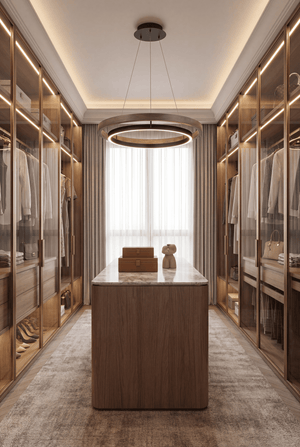
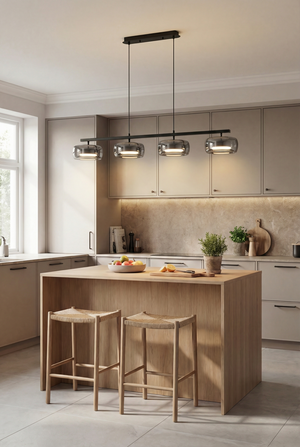
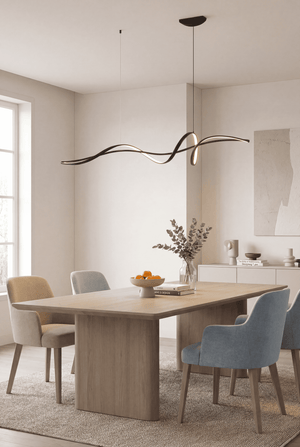
Our range of pendant lights ideally complements this approach by creating mid-level lighting zones above tables or central islands. This layered lighting enriches the ambience while improving the functionality of the spaces.
Smart management systems make it possible to program lighting scenes that combine different sources. These advanced setups automatically adjust lighting according to the time, season, or personal preferences, maximizing comfort and energy efficiency.
Frequently asked questions
What is the minimum ceiling depth required to install recessed spotlights?
Recessed LED spotlights require a minimum depth of 8 cm for compact models and up to 12 cm for more powerful versions. This dimension includes the ventilation space essential for proper LED operation. Concrete ceilings may require specific housings, increasing this constraint.
How many recessed spotlights are needed to light a 20 m² living room?
For a 20 m² living room, plan for 6 to 8 7-watt spotlights evenly spaced, producing about 4,000 to 5,000 lumens in total. This setup meets the recommendation of 200 to 250 lm/m² for comfortable general lighting. The optimal spacing between spotlights is 1.5 to 2 meters.
Can a ceiling light replace several recessed spotlights?
A 40 to 60 watt ceiling light can indeed replace 6 to 8 recessed 7-watt spotlights in terms of total luminous flux. However, the light distribution differs: the ceiling light provides more uniform lighting, while spotlights create higher-contrast areas. The choice depends on the effect you want.
What is the comparative lifespan between LED spotlights and ceiling lights?
Quality recessed LED spotlights offer a lifespan of 25,000 to 30,000 hours, while ceiling lights generally reach 40,000 to 50,000 hours thanks to better thermal management. With daily use of 4 hours, this represents 17 and 25 years of operation respectively, with variations depending on component quality.