
Winter lighting for well-being: creating a warm atmosphere
When the days get shorter and natural light becomes scarce, our body immediately feels these changes. The drop in daylight exposure disrupts our circadian rhythm and can cause fatigue, low spirits, or even seasonal depression. That’s why winter lighting becomes a major factor for our well-being and deserves special attention in the design of our interiors.
The impact of winter light on our body
Our body operates on a 24-hour biological rhythm, regulated mainly by exposure to light. In winter, we lose up to 6 hours of natural daylight per day compared to summer. This drastic decrease affects the production of melatonin (the sleep hormone) and serotonin (the happiness hormone).
The consequences appear quickly: sleep disorders, decreased energy, increased irritability, and sometimes seasonal affective disorder affecting 3 to 8% of the French population. Faced with these physiological challenges, well-designed indoor lighting becomes your health ally to compensate for the lack of natural light.
Color temperature and psychological well-being
Color temperature, measured in Kelvin (K), directly influences our psychological state. Warm light between 2700K and 3000K stimulates melatonin production in the evening and promotes relaxation. Conversely, cool light from 5000K to 6500K mimics daylight and keeps you alert.
To optimize your winter well-being, favor warm lighting in the evening with dimmable lighting that allows you to gradually reduce the intensity. This approach respects your natural circadian rhythm and prepares your body for sleep.
Choosing the right lighting for each room in winter
Living room: creating a cozy atmosphere
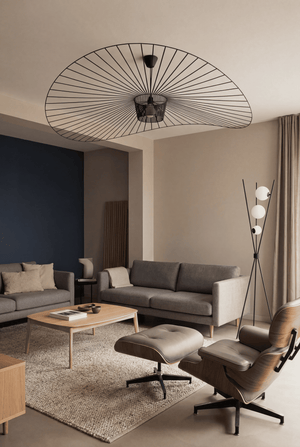
The living room becomes the heart of your home during winter. To transform this space into a haven of peace, opt for multiple complementary light sources rather than a single central light. Designer pendant lights with dimming functions are a smart choice above your coffee table or dining area.
Complete with accent lamps placed strategically: a reading lamp near your favorite armchair, another on a console to indirectly light a wall. This multi-layered lighting strategy creates intimate zones and avoids the "operating room" effect of overly uniform lighting.
For intensity, aim for 100 to 150 lumens per square meter for general lighting, with brighter zones (300 lumens/m²) for activities like reading. Today’s LEDs offer CRI (Color Rendering Index) values above 90, perfectly revealing the warm tones of your winter decor.
Bedroom: preparing for restorative sleep
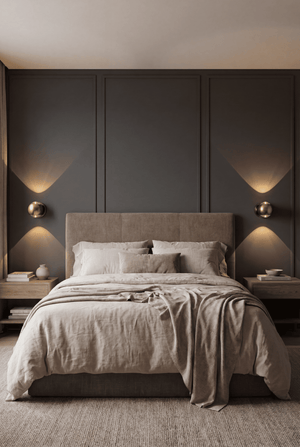
The bedroom requires a particularly delicate approach in winter. The goal: make it easier to fall asleep and respect your sleep cycle despite seasonal disruptions. Ban direct ceiling lighting in favor of indirect and adjustable light sources.
Wall sconces installed on either side of the bed, at a height of 1.70m to 1.80m, provide perfect lighting for reading while preserving a cozy atmosphere. Choose adjustable models to direct the light toward the wall or ceiling, creating a soothing indirect light.
A professional tip: install a dimmer switch to reduce the intensity to 10% of its maximum power. This residual light, called a "night light," maintains your spatial orientation without disrupting your melatonin.
Dining room: maintaining winter conviviality
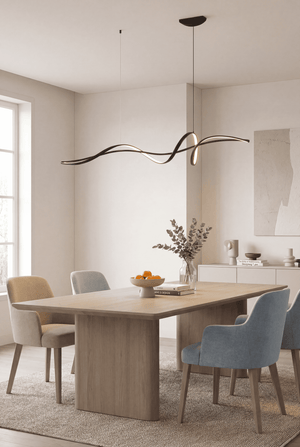
Winter meals gain social and psychological importance. Your lighting should enhance these moments of sharing while compensating for the early darkness outside. A pendant light above the table, positioned between 70 and 80 cm high, visually structures the dining area.
Choose a model with a lampshade that directs light downward while diffusing some toward the ceiling. This dual diffusion prevents harsh shadows on faces and maintains a warm atmosphere conducive to conversation. The ideal intensity is around 200 lumens per square meter for the table area.
Professional lighting techniques for winter
Luminous layering: the three-layer strategy
Lighting professionals systematically apply the rule of three lighting layers, which is especially relevant in winter. This method layers general lighting, accent lighting, and task lighting to create a visually rich and psychologically comfortable environment.
General lighting, provided by ceiling lights or chandeliers, supplies the base illumination of 50 to 100 lumens/m². Accent lighting, via wall sconces or directional spots, highlights textures and colors with 200 to 300 lumens/m² locally. Task lighting meets specific needs: at least 300 lumens/m² for reading, 500 lumens/m² for precise tasks.
Timed lighting management
Winter requires a timed approach to your lighting to compensate for natural variations. From 4pm, anticipate nightfall by gradually turning on your light sources. This gentle transition avoids the psychological shock of sudden darkness.
Between 4pm and 6pm, opt for 4000K light (neutral white) to maintain alertness for late afternoon activities. After 6pm, gradually switch to 2700K-3000K to prepare for relaxation. Dimmable fixtures make this transition easier by allowing a gradual decrease in intensity.
Optimal positioning of light sources
Winter changes our spatial perception of interiors. Lighting angles become crucial to maintain a sense of space and warmth. Avoid light sources that create harsh cast shadows, which are particularly unpleasant when natural light is lacking.
For floor lamps, position them in the corners of the room for indirect lighting that bounces off the walls. This technique, called "wall washing," visually enlarges the space and creates a cozy atmosphere. A minimum height of 2.10m from the floor ensures even distribution without glare.
LED technologies and winter well-being
Advantages of LEDs for visual comfort
LEDs are revolutionizing winter lighting thanks to their technical performance tailored to well-being. Unlike traditional bulbs, they do not heat up, preventing the drying out of indoor air already weakened by heating. Their lifespan of 25,000 to 50,000 hours ensures consistent light quality throughout the season.
The CRI (Color Rendering Index) of high-end LEDs now reaches 95, faithfully revealing the nuances of your decor. This color accuracy combats winter visual monotony and maintains the aesthetic appeal of your interior despite the grayness outside.
Dimming function and energy savings
The compatibility of LEDs with dimmers opens up new possibilities for your winter well-being. Dimmable lighting consumes proportionally less energy depending on the selected intensity. At 50% intensity, you save about 40% on electricity consumption.
This energy flexibility is particularly interesting in winter when lighting is used more. The payback period for quality LED fixtures is generally 2 to 3 years, during which you fully benefit from their advantages for your well-being.
Colors and materials to amplify the well-being effect
Harmonizing lighting and color palette
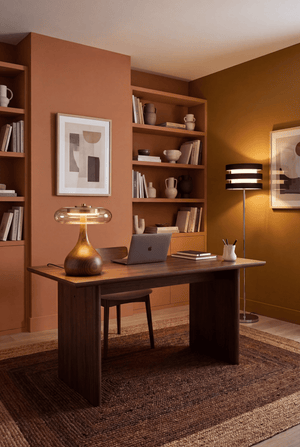
Winter lighting reveals or alters the colors of your decor. Warm light at 2700K enhances warm tones: red, orange, yellow, natural woods. These psychologically comforting shades create a cozy atmosphere essential for winter well-being.
Avoid combining warm light with cool colors (blue, cool green, gray), which would appear dull and have a depressing effect. If your decor favors these tones, opt for neutral white lighting (4000K) to preserve their vibrancy while maintaining a pleasant atmosphere.
Diffusing materials and light quality
Lampshades and diffusers significantly influence visual comfort. Natural materials such as linen, cotton, or wood pleasantly soften the light and create a reassuring organic atmosphere in winter. They prevent direct glare while maintaining lighting efficiency.
The opal or frosted diffusers of modern light fixtures offer a contemporary alternative, producing a uniform light without visible hot spots. This even diffusion reduces eye strain, which is especially appreciated during long winter evenings.
Seasonal maintenance and optimization
Winter cleaning of light fixtures
Winter accumulates dust and particles on your fixtures, reducing their efficiency by up to 30%. Monthly cleaning of diffusers and reflectors maintains optimal light quality. Use a slightly damp microfiber cloth for smooth surfaces, a soft brush for complex textures.
This preventive maintenance preserves not only the light intensity but also the appearance of your fixtures. Clean diffusers ensure even light distribution, avoiding unpleasant shadow areas for your daily visual comfort.
Adapting to changing needs
Your lighting needs change during winter depending on your activities and psychological state. Anticipate these changes by preparing different lighting scenarios: energizing lighting for tough mornings, soft ambiance for relaxing evenings, functional lighting for winter remote work.
Timers and programmers allow you to automate these transitions, creating regular lighting rhythms that benefit your biological clock. This artificial regularity partially compensates for the natural irregularity of winter light.
Frequently asked questions about winter lighting
What color temperature should you choose to boost your mood in winter?
Choose 2700K to 3000K (warm light) in the evening to promote relaxation and melatonin production. During the day, 4000K (neutral white) maintains alertness. Avoid temperatures above 5000K, which can disrupt your circadian rhythm.
How many light sources should you install in a 20m² living room in winter?
For 20m², plan for 4 to 5 complementary sources: 1 main light (pendant or ceiling fixture) of 2000-3000 lumens, 2-3 accent lamps of 800-1200 lumens each, plus 1-2 accent sources (sconces or spotlights) of 400-600 lumens.
At what height should you install a wall sconce in a bedroom?
Install wall sconces between 1.70m and 1.80m from the floor, 60-80cm on each side of the bed. This position optimizes reading light while avoiding direct glare. For adjustable models, direct the light toward the wall or ceiling.
Do dimmable LEDs really use less energy in winter?
Yes, a dimmable LED at 50% intensity uses about 40% less energy. With winter use of 8 hours/day for 4 months, this represents a saving of €35-50 per 15W fixture, depending on current electricity rates.